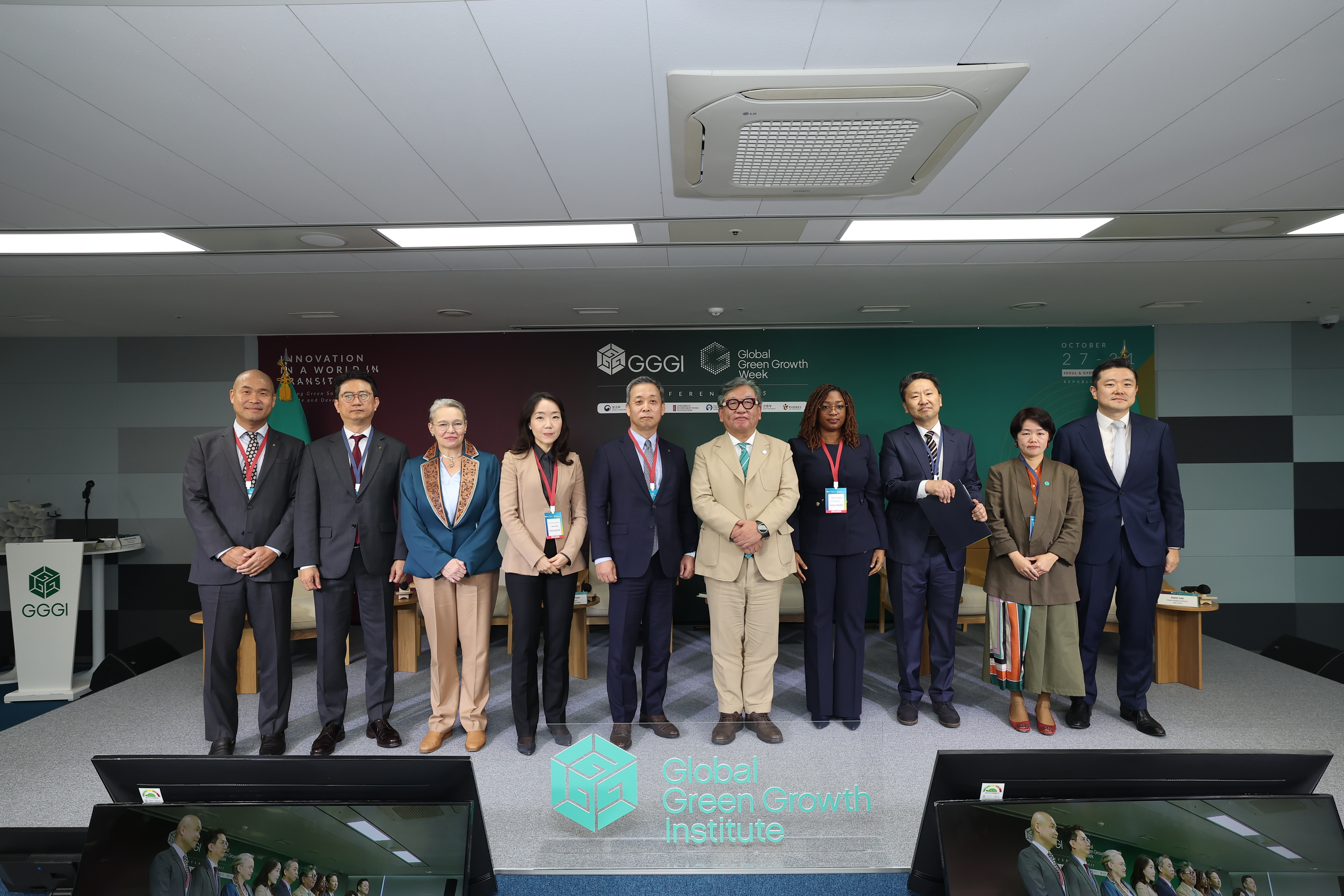


Inspired by the session “Catalyzing Green Entrepreneurship and Climate Tech for Sustainable and Inclusive Development” at GGGWeek 2025
Seoul, 27 October — Global Green Growth Week, GGGI Headquarters
The session opened with a clear focus on how green entrepreneurship and climate technology can drive sustainable and inclusive economic development. Across many developing and least developed countries, climate innovation is progressing, but financing and policy support often lag behind, leaving promising solutions unable to scale. This discussion brought together policymakers, investors, and practitioners to consider how innovation and capital can be aligned to turn climate tech from small pilots into market-ready industries.
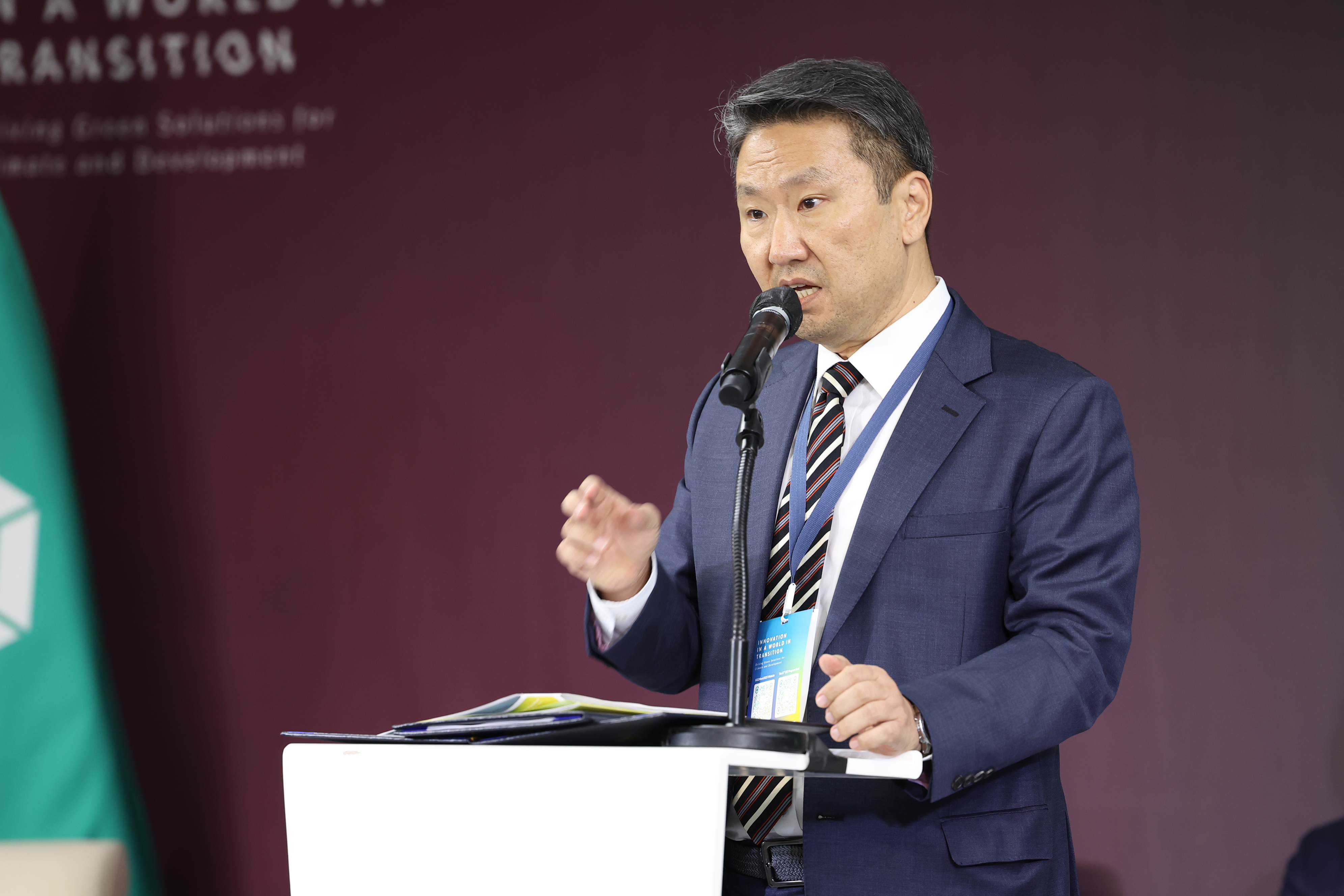
Within this context, Jaeseung Lee, Deputy Regional Director for Asia at GGGI, opened the session, noting that the Collaborative Research, Development and Business (R&DB) Programme for Promoting the Innovation of Climate Technopreneurship had been 5 years in development. A Memorandum of Understanding (MoU) between GGGI and NH Investment & Securities, signed earlier that morning, formalized this collaboration under the Green Climate Fund (GCF)-supported program. This strategic framing creates a direct bridge between high-level collaboration and the operational design choices that follow.
GGGWeek 2025
From Partnership Foundations to a Platform for Scale
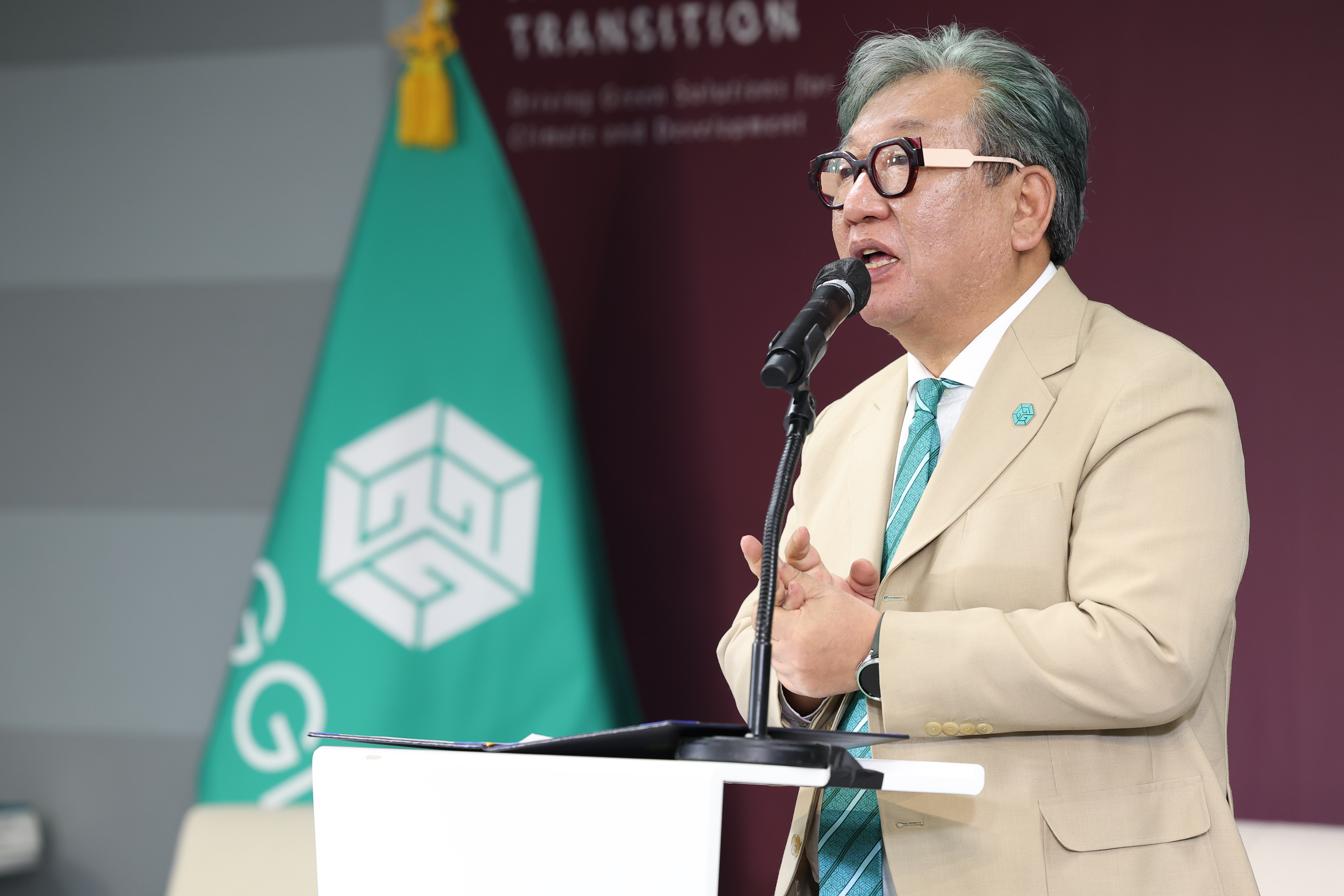
Opening the event, Sang-Hyup Kim, Director-General, Global Green Growth Institute, framed the partnership as a deliberate convergence of policy, finance and entrepreneurship. The collaboration among NH Investment & Securities, the Korea Development Bank (KDB) and the GCF, implemented in partnership with GGGI, is designed to systematically accelerate climate technopreneurship across Cambodia, Indonesia, Lao PDR, the Philippines and Viet Nam. The ambition is tangible: 1.64 million tCO₂e in emissions reductions, 2.3 million direct beneficiaries and new green jobs rooted in local economies. As he put it, GCF “is about money” and GGGI “about work on the ground”—a complementary partnership to move technologies from promise to practice. That strategic intent carried through to the investment envelope. The partnership centers on a USD 200 million equity fund nested within a USD 221 million program, combining equity and grants to mobilize private capital at speed and at scale.
GGGWeek 2025
Program Architecture: From Acceleration to Investment-Ready Ecosystems
Providing the technical overview, Seung-yeon Stella Lee, Country Representative, GGGI Uzbekistan, who has been leading the design of the Programme from the GGGI side for the past years, traced the program’s evolution from concept to design. The architecture rests on four mutually reinforcing components. First, GGGI and KDB accelerate high-potential local startups, so they are investment-ready and able to partner credibly. Second, NH Investment & Securities sources proven global climate technologies and brokering joint ventures or subsidiaries that transfer know-how and technologies into local markets. Third, NH Absolute Return Partners (NHARP) deploys GCF-backed blended finance to scale ventures that clear technical and commercial thresholds. Fourth, GGGI and KDB strengthen local policies, institutions and capacities, so ecosystems for climate technology, industry and business continue to produce investable opportunities.
Lee emphasized that this will be the first regional climate technology transfer fund aligned with the United Nations Framework Convention on Climate Change (UNFCCC) guidance—a model designed expressly for replication beyond the initial five countries.
Financing the transition: risk-sharing that crowds in private capital
Translating architecture into investability, Kijung Kwon, Managing Director, NHARP, detailed how the USD 200 million fund will function. Structured as a Singapore Limited Partnership (LP) with GCF first-loss capital, the fund targets an 8% preferred return for senior LPs and an overall Internal Rate of Return (IRR) of around 10%, acknowledging that rigorously measured social value adds to the program’s total return. Three closings are planned (USD 90m, USD 40m, USD 70m), with a net deployable amount near USD 160m after costs. However, architecture alone does not mobilize capital; the investment vehicle must distribute risk and signal commercial viability to private markets.
Investment will prioritize Series C–E growth-stage companies—firms whose technologies are proven and ready for market expansion—while reserving space for 20–30 earlier-stage startups to nurture local venture startup ecosystems. The sectoral focus spans renewables, energy storage, low-carbon transportation, smart buildings/energy efficiency (mitigation) and water, waste/circular economy, and agri-tech (adaptation). Instruments will include equity, debt, mezzanine and structured finance investments in climate tech companies/projects, with exits expected primarily via M&A or structured buybacks suited to joint-venture settings.
Critically, the fund is not designed to back prototypes in isolation. NH Investment & Securities’ carbon finance team will court “global-standard” technology firms—often headquartered in markets with smaller domestic demand (for example, Korea, Japan, Singapore, Australia, several European states)—and match them with credible partners from the five target countries. GGGI and KDB will collaborate with the government and local implementing entity to resolve regulatory pathways as well as identify local startups in five countries and provide the essential acceleration service to ensure that technology transfer is impactful and sustainable.
Reinforcing the financial community’s role, Byung-Un Yoon, President & CEO, NH Investment & Securities, affirmed that responding to the climate crisis is no longer optional. The firm’s commitment is to apply its financial expertise and networks to make the program’s pipeline bankable and its outcomes durable.
Why this matters now: the innovation gap to net zero
Connecting the finance conversation to climate physics, Juhern Kim, Country Representative, GGGI Viet Nam, reminded the room of the innovation arithmetic: existing commercial technologies can deliver only about 30% of the reductions needed for net zero, leaving approximately 70% to come from technologies still moving from prototype to demonstration to early commercialization. “We need entrepreneurs, we need innovation, we need startups, and then we need relevant capital to deliver that goal,” he noted. That reality emphasizes the importance of risk-sharing on investment, regulatory sandboxes and direct impact indicators as prerequisites for impact at the pace required.
Inclusion by design: policy that starts with people
With the financial structure established, the session shifted to the enabling environment required to sustain innovation across country contexts. The panel then widened to national enabling conditions. Karen Diallo, Director of Digital Transformation of the Administration, Ministry of Digital Transition and Digitalization, Côte d’Ivoire, described that “sustainability and inclusion are no longer adds-on, they are built-in.” National AI strategy development involved country-wide public consultations, digital public services are being localized into multiple Ivorian languages by a startup, and “digital caravans” bring foundational skills to communities that have had little direct exposure to computers or the internet. The organizing principle is simple but exacting: policies must center people, not technologies, so that youth, women and persons with disabilities shape—and benefit from—the innovation economy.
From the finance side, Se-Kyung Park, Head of the Climate Business Team, KDB, outlined how a policy financial institution mobilizes capital across the innovation life cycle. KDB NextRound convenes investor-relations sessions by business stage, from seed through pre-IPO, three days a week in Seoul while operating venture desks in New York, London, Singapore and Silicon Valley. For climate technology business and entreprises, this kind of stage-matched, market-facing intermediation helps crowd in private investors without diluting public-interest objectives.
International partnership then took center stage. Robyn McGuckin, Executive Director, P4G, highlighted that since 2018, P4G has supported 135+ climate-startup initiatives, committing USD 48 million and helping leverage USD 525+ million more in investment, creating 1,600 jobs and already achieving 1.64 million tCO₂ in verified reductions. The through-line is an ecosystem logic: when the public sector leads with a credible vision, private capital follows with innovation and scale.
Addressing risk and readiness: how the model navigates context
Audience questions pressed on a familiar challenge: how to operate across jurisdictions where informal economies are large, and regulatory systems are still maturing. Kijung Kwon clarified that commercial growth for Series C–E firms will continue in their home markets, while impact is generated through technology transfer and local market creation through joint ventures with local startups in the five target countries. Here, GGGI and NH Investment & Securities will work with governments on approvals, compliance and enabling reforms, while capacity-building under the technical-assistance component equips local partners to absorb and sustain the transferred technologies.
Jaeseung Lee distilled the operating logic: find leading technologies, pair them with credible partners and share risk through blended finance so that climate impact and commercial viability reinforce rather than undermine each other.
Closing synthesis: collaboration as the operating system
The session closed on a shared understanding: climate innovation will not scale through technology alone. It requires ecosystems that match capital with capability, global solutions with local ownership, and policy ambition with institutional readiness. With the memorandum of understanding now formalized, the work moves from design to delivery: selecting pipeline enterprises, structuring investments, verifying climate and social outcomes, and strengthening the networks that allow innovation to take root. The premise is clear and widely held across the session—green and climate entrepreneurship can advance both decarbonization and inclusion, provided finance is catalytic, policy incentives are coherent, and technology transfer is genuine and embedded in local capacity.
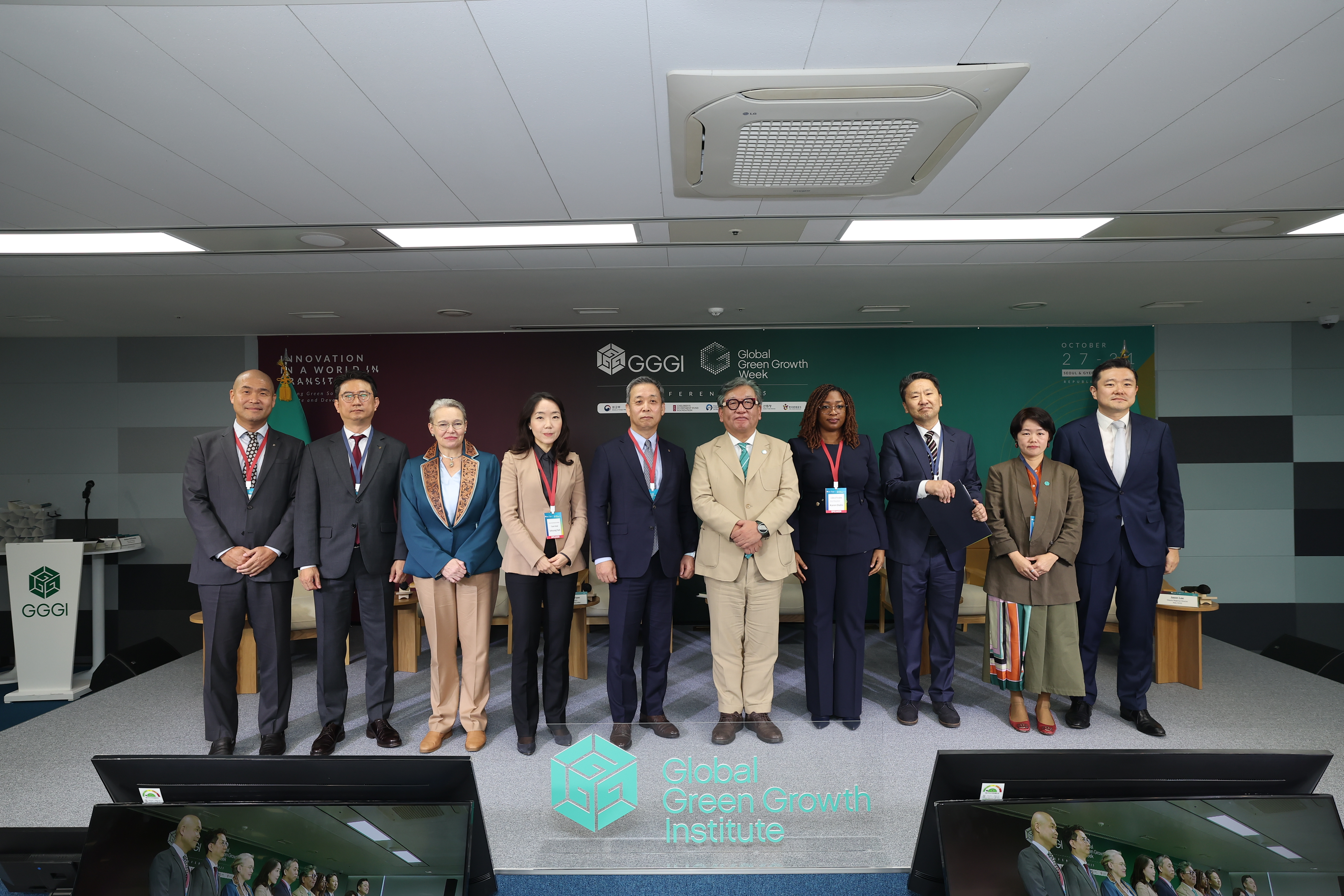
GGGWeek 2025
Photos @2025 Global Green Growth Institute
Watch the session recording: