This the virtual space for the Global Development, Review and Update of National Implementation Plans (NIPs) under the Stockholm Convention (SC) on Persistent Organic Pollutants (POPs) Project. 

Group members are welcome to share their experiences and expertise on the NIPs update process.

Upcoming Events

Development, review and update of National Implementation Plans (NIPs) on Persistent Organic Pollutants (POPs)

A post is already pinned to this stream. Would you like to replace it?
Green Growth Knowledge Partnership(GGKP)

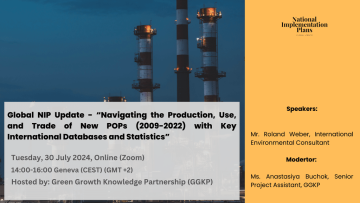
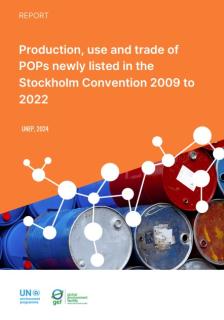
On 30 July 2024, the Green Growth Knowledge Partnership (GGKP) hosted a webinar on "Navigating the Production, Use, and Trade of New POPs (2009-2022) with Key International Databases and Statistics." The session provided a practical overview of newly listed persistent organic pollutants (POPs) and… Read More

 Industrial Persistent Organic Pollutants (POPs) are present in polymers and wood in buildings and construction, in plastics in electrical and electronic equipment (EEE), vehicles, textiles and a range of other consumer goods. These uses result in human exposure indoor, in environmental… Read More

 The main objective of creating inventories of persistent organic pollutants (POPs) is to gather information that is essential for managing POPs, developing and reviewing National Implementation Plans (NIPs), and meeting the information requirements outlined by the Stockholm Convention. These… Read More

For the inventory, management, control, and reduction of persistent organic pollutants (POPs), it is essential to have information about their current production, trade, and uses. It is also important to consider that industrial POPs that have been used in the past may still be present in… Read More

Green Growth Knowledge Partnership(GGKP)

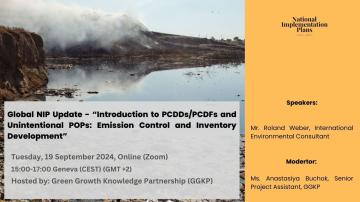
On 19 September 2024, the Green Growth Knowledge Partnership (GGKP) hosted the online training webinar "Introduction to PCDDs/PCDFs and Unintentional POPs: Emission Control and Inventory Development". Read More

Green Growth Knowledge Partnership(GGKP)

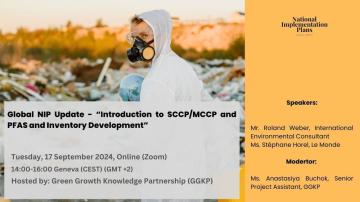
On 17 September 2024, the Green Growth Knowledge Partnership (GGKP) hosted the online training webinar "Introduction to SCCP/MCCP and PFAS and Inventory Development". Read More

Dear NIP Colleagues!

We are pleased to share the package of educational materials that facilitate the data collection exercise. These materials shall be helpful during both current and future updates to National Implementation Plans (NIPs). The introduced information reflects key aspects from POPs inventories guidance documents, but we kindly recommend consulting the original guidance documents for more details or updates.

The package contains the following:
1. General information on POPs data collection
2. Data collection of POPs pesticides
3. Data collection of PCBs
4. Data collection of POP-PBDEs
5. Data collection of HBCDs
6. Data collection of PFOS
7. Data collection of PCPs
8. Data collection of PCNs
9. Data collection of SCCPs
10. Data collection of HCBDs
11. Data collection of uPOPs

For more details, please feel free to contact our colleague, Ms. Mihaela Claudia Paun - [email protected], Programme Management Officer, UNEP.

Read More

pdf20240524_POPs_data_collection (educational pack).pdf10.78 MB

Dear colleagues!

As most of the project countries completed their inception meetings, and are preparing for inventory exercise, we are happy to share the Guidance on Information Collection for Industrial Persistent Organic Pollutants!

Read More

pdfUNEP-POPS-NIP-GUID-12-Inventory-InfoCollection-2023.English.pdf388.12 KB

Dear colleagues!

We are happy to share with you the links to the Integrated Electronic Toolkit for submission of National Implementation Plans developed by UNEP upon specific requests outlined in key decisions (paragraph 8 (e) of SC-8/8 and paragraph 3 of SC-8/17, paragraph 7 (c) of SC-9/9, SC-9/16) of the Stockholm Convention.
Please feel free to explore the toolkit by following the link below!

Read More

https://nips.pops.int/index.html

Hello NIP colleagues!

Sharing another valuable piece of information on POPs developed by IPEN with you!

Waste incineration is often presented as a solution to waste management issues, offering an alternative to landfills. However, this process results in the generation of toxic ash and residues, constituting approximately 30% of the original waste volume. Unfortunately, these byproducts are often improperly disposed of, leading to environmental pollution and potential exposure to Persistent Organic Pollutants (POPs). Municipal waste incineration not only destroys valuable resources but also transforms non-toxic materials into hazardous ash. The report highlights the inadequate regulation of waste incineration, emphasizing the need for globally adopted "Low POPs Content Levels" to treat and destroy POPs-contaminated residues. Key findings reveal a significant underestimation of dioxins in waste incineration fly ash, raising concerns about its widespread reuse, especially in agriculture, posing risks to food chains. The report advocates for a phased-out approach to waste incineration in favor of non-combustion waste treatment methods, addressing the global impact of toxic ash on the environment and human health.

Read More

https://ipen.org/sites/default/files/documents/ipen-toxic-fly-ash-in-food-v2_3-en.pdf