
Q&A Summary: Activity Options for Action Plans for Brominated, Chlorinated and Other New POPs (22 January 2026)
GGKP is happy to share the answers from Dr. Roland Weber to the participants' questions raised during our recent webinar on developing effective action plans for brominated, chlorinated, and other newly listed POPs under the Stockholm Convention!
Q1. How do the costs of treatment options for plastic POPs compare, and what factors should be considered in choosing a treatment method?
Dr. Roland Weber: The cheapest option for the thermal destruction of plastics containing POPs is normally cement kilns, which can utilize plastics as fuel. The price depends on negotiation. However, cement kilns have a limit for halogens (in particular chlorine and bromine) and need to calculate how much of a halogen load they can take without experiencing operational troubles. So, the halogen content is key to choosing treatment options. Also, the costs for destruction in hazardous waste incinerators in Europe depend strongly on the halogen content. One option can be solvent-based recycling, which can separate polymers from additives. If solar energy is used for energy production, the process can be cheap and sustainable.
Q2. How important is lifecycle assessment in evaluating the sustainability of substitutes for plastics, and what criteria should be prioritized?
Dr. Roland Weber: Life cycle assessment (LCA) is of key importance in evaluating the sustainability of substitutes for plastics. There are standardized methods for conducting LCAs which should be applied (ISO 14040 and ISO 14044). But there are also deficiencies in LCA in addressing the plastic problem (see Miller 2022: https://doi.org/10.3389/frsus.2022.1007060).
I suggest having a look at some reviews on the LCA of plastics and alternatives: https://journals.sagepub.com/doi/pdf/10.1177/0734242X241241606
What seems to not have been adequately addressed by LCAs is the environmental burden, which several authors highlighted and need to be better taken into account. See the review by Gomez: https://doi.org/10.1016/j.spc.2021.11.021
Q3. How do you imagine the management of POPs in plastics where there are only limited capacity and infrastructure to manage plastic waste, particularly in developing countries?
Dr. Roland Weber: One key is the financing of waste management, and Extended Producer Responsibility (EPR) is one part of the solution. The Basel Convention has a Forum on Extended Producer Responsibility for Plastic Wastes (https://www.basel.int/Implementation/Plasticwaste/PlasticWastePartnership/EPRForum/tabid/9658/Default.aspx), and we have tried in our webinar to give an introduction to the status of EPR and link to global initiative(s). However, I also support the reduction of overall plastic use and the application of the essential use concept for plastics.
Q4. Are there defined limit values for new industrial POPs to determine whether the articles or products containing them are contaminated?
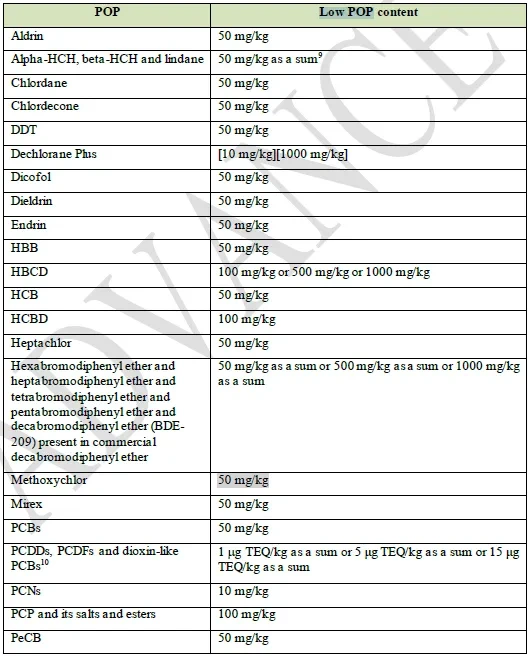
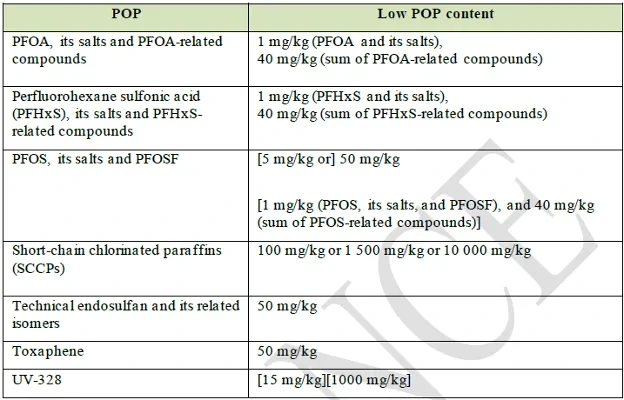
Dr. Roland Weber: The Basel Convention has Low POP Content (LPC) limits for POPs which define if a waste is considered a POP waste. The current LPC limit values are listed in the Basel Convention (see the attached Table 1: Provisional definitions of low POP content limit values) [1].
The POPs limits for products are called Unintentional Trace Contaminant (UTC) limits. There are no defined UTC limits prescribed in the Stockholm or Basel Conventions, but countries are developing UTC limit values to regulate POPs in products. The most comprehensive regulation is the European POPs Directive which includes a list of UTC limits in Annex 1 of the EU POPs Regulation. The consolidated version with all amendments can be downloaded here [2].
In the recent GGKP webinar on action plan options for unintentional POPs, UTC limits of the EU were introduced and recorded here [3].
[1] UNEP (2025) General technical guidelines on the environmentally sound management of wastes consisting of, containing or contaminated with persistent organic pollutants. UNEP/CHW.17/5/Add.1/Rev.1
[2] REGULATION (EU) 2019/1021 OF THE EUROPEAN PARLIAMENT AND OF THE COUNCIL of 20 June 2019 on persistent organic pollutants https://eur-lex.europa.eu/legal-content/EN/TXT/PDF/?uri=CELEX:02019R1021-20251203
[3] GGKP (2025) Activity Options for Action Plans on the Reduction of uPOPs and Management of PFASs. https://www.greenpolicyplatform.org/webinar/activity-options-action-plans-reduction-upops-and-management-pfass
For a deeper dive into the GGKP webinar “Activity Options for Action Plans for Brominated, Chlorinated and Other New POPs”, you can access the full recordings and materials below.